A Korean missionary being held in Khabarovsk, Russia now faces a maximum of 17 years in prison on a total of three immigration-related charges. Last week, investigators filed two new charges against Missionary Park Tae-yeon and were granted a one-month extension to continue their investigation, which has so far lasted two months. The initial court hearing is now likely to occur in late April.
That’s the update from persecution watchdog Voice of the Martyrs Korea, which has been advocating for the release of Missionary Park since her arrest on January 15, one week before she was scheduled to return home to Korea to retire at age 70. The missionary continues to be held at an immigration detention center.
According to Voice of the Martyrs Korea CEO Pastor Eric Foley, authorities have also seized Missionary Park’s house in Russia and fined the missionary for overstaying her visa, despite the overstay being due to her detainment by Russian authorities. Pastor Foley calls these actions “serious violations of the law that demand remedy by the court and the action of Christians around the world on Missionary Park’s behalf.”
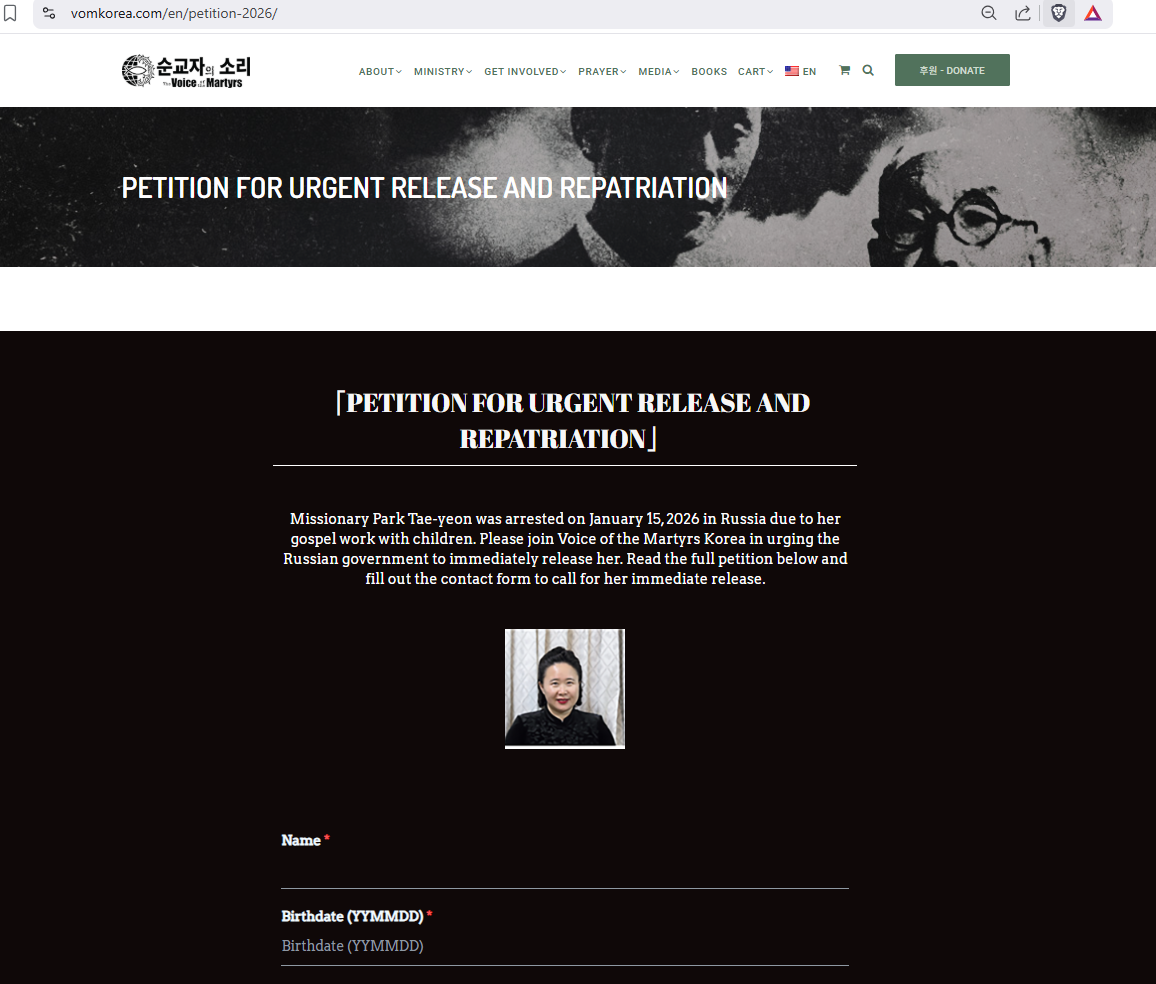
Voice of the Martyrs Korea has posted a petition online at https://vomkorea.com/en/petition-2026 calling for Missionary Park’s immediate release. Pastor Foley says that so far more than 3,700 people in Korea have added their names to the petition, along with 750 people from the United States, Australia, Canada, Japan, New Zealand, the United Kingdom, South Africa, Brazil, Africa, and Finland. Pastor Foley says he and Voice of the Martyrs Korea Representative Dr. Hyun Sook Foley will deliver the petition to the Russian Embassy in Seoul once 5,000 signatures are secured.
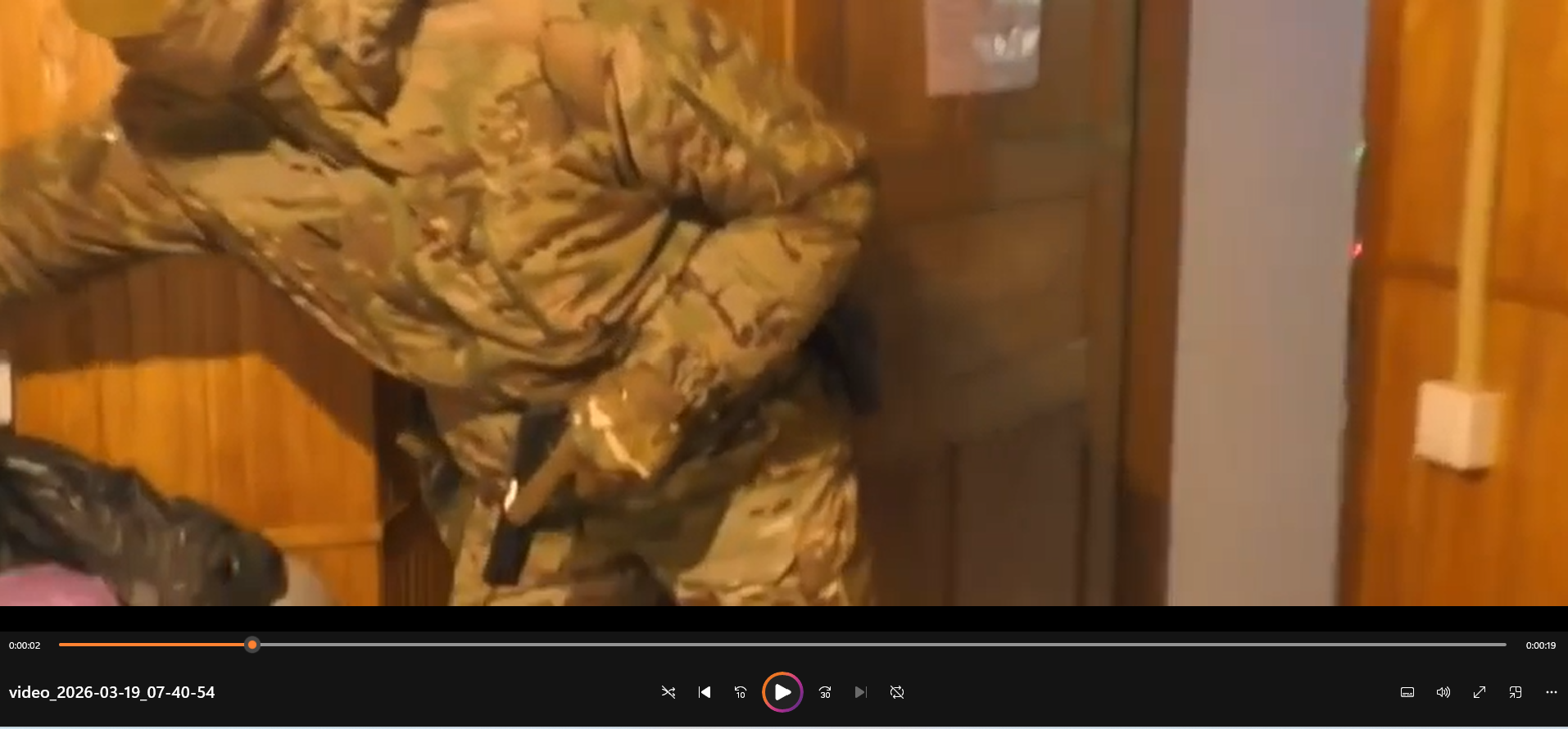
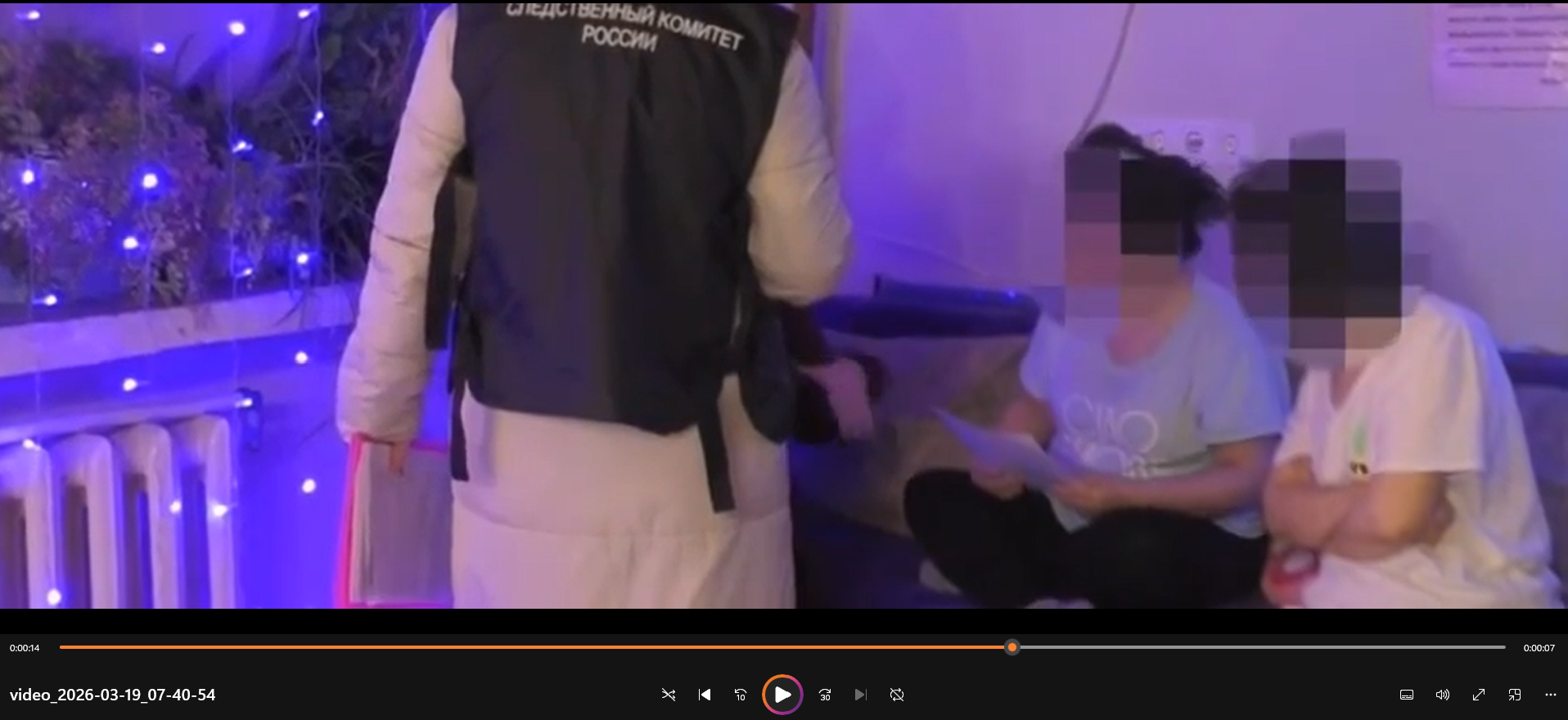
Screenshot from a video of Missionary Park’s arrest posted on the Биржа политиков – Хабаровский край (Political Marketplace – Khabarovsk Krai Telegram Channel )
“We need to let Russian authorities know that the world is watching to see how they will treat this 70-year old single woman who for more than 30 years said she was ‘married to Russia’, serving Russian people—especially children—with her whole heart, with not even a single complaint against her during that time,” says Pastor Foley. He says that more than a dozen people in Russia and Korea have stepped forward to provide official character references to submit to the court on Missionary Park’s behalf.
Pastor Foley says that the three charges against Missionary Park are all immigration-related and deal with assistance Missionary Park allegedly provided to Koreans to enter Russia. Two of the charges carry maximum 5-year sentences, and the third carries a maximum 7-year sentence, leading to a possible maximum 17-year sentence between the three charges. He says although the charges are explicitly immigration-related, Voice of the Martyrs Korea remains concerned that the motivation for the charges is religious.
“Voice of the Martyrs Korea obtained copies of a notification sent out in January by the Khabarovsk Department of Education to educational and other child care institutions in the area. The notification says in part, ‘In the capital of the region, a citizen of South Korea, an agent of an American organization Park Tae-yeon’s Child Evangelism Fellowship set up a brainwashing machine for children, instilling values alien to our society and drawing them into the practice of the Korean-American form of Protestantism.’ The statement continues: ‘Russian children were set against the family and the state, and Park Tae-yeon herself was presented to them as the main life guide. The camp was carefully conspiratorial.’ The notification concludes: ‘Park Tae-yeon intended to take Russian children to South Korea for final zombification, but did not have time. Now Park Tae-yeon has been detained, a criminal case has been opened for organizing illegal migration.’”
Screenshot from a video of Missionary Park’s arrest posted on the Биржа политиков – Хабаровский край (Political Marketplace – Khabarovsk Krai Telegram Channel )
Pastor Foley says that similar reports appeared in state-affiliated Russian media in late January.
“The criminal charges and media campaign against Missionary Park reflect the continued decline in religious freedom across the Russian Federation, particularly as it relates to Protestant Evangelicals,” says Pastor Foley. “The 2025 US Commission on International Religious Freedom report on Russia says, ‘Russia criminalizes the activities of several peaceful religious groups by designating them as “terrorist,” “extremist,” or “undesirable,” despite no evidence of their promotion of or participation in violence.’ That’s exactly what we see in the case of Missionary Park. Her activity hasn’t changed for more than 30 years, The only thing that has changed is that now Russian authorities calls people like her ‘extremists’, ‘brainwashers’, and ‘conspirators against Russia’, despite all common-sense evidence to the contrary.”
Since 2021, the United States has designated Russia as one of 12 ‘Countries of Particular Concern’ for religious freedom violations, along with countries including China, Iran, North Korea, Pakistan, and Cuba.
Most of the dramatic North Korean martyr stories you read in the news are simply not true. Typically, when a North Korean is caught with a Bible, the North Korean is arrested and taken to a concentration camp.
It is not dramatic. It does not make the news. And Christians around the world never hear about it.
Several years ago, Mrs. Park, a North Korean defector, told us about her husband, who was an underground North Korean Christian. He met a family in China who had told him about the “Good News of Jesus Christ”, and upon his return to North Korea he wouldn’t stop talking about God and about the Bible.
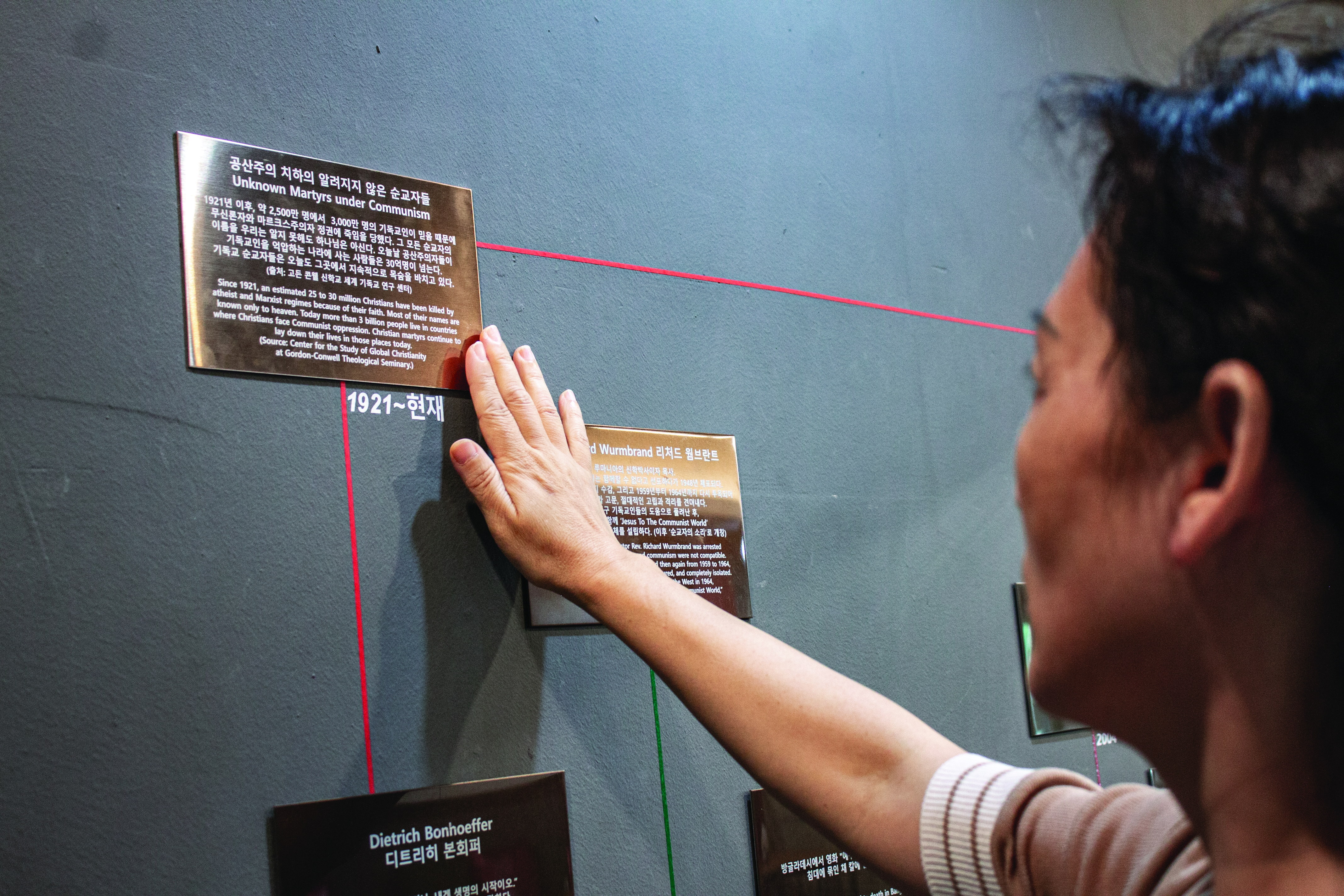
Mrs. Park, whose husband was martyred inside of North Korea looks at the “Unknown Martyrs of Communism” plaque on the martyr’s timeline at the Voice of the Martyrs office.
Although he knew his entire family could be severely punished for his bold faith, he shared the message of Jesus with at least 20 other people. Mrs. Park told us that at the time, she thought he was crazy.
Eventually, someone reported on his activities. One night, authorities came to the couple’s home and arrested both of them. Because of a relative she had in the State Security Police, she was only sent to a labor camp and served six years. He was immediately taken to a concentration camp and never heard from again.
Arrested. Sent to a concentration camp. Never heard from again.
This is the common way that the North Korean government deals with underground Christians. It’s not flashy and most news agencies don’t consider it newsworthy. The world will never hear about these North Korean underground Christians. They are a part of the unknown martyrs of North Korea, but they are known to God.
“I cannot deny the Bible”
Recently, we came to know about a teenage North Korean girl named Suji. She and her whole family were Christians inside of North Korea. Shortly after coming back from China to North Korea, the authorities searched their home for contraband they acquired in China. We suspect they were looking for a fishing rod, but instead they discovered a Bible.
The whole family was immediately arrested by state security agents and interrogated, but the father successfully convinced the agents that Suji and her brothers were in no way responsible for or connected to the Bible. Suji and her brothers were later released.
During the interrogation, one agent told Suji’s mother, “If you deny the Bible, we will let you go.” But she responded, “There is nothing wrong in the Bible. So, I cannot deny it.” Suji’s father and mother were never heard from again, even to this day.
A North Korean Christian was martyred and left behind the three children in the photo. The story of the martyr is unknown to most people around the world.
Suji’s parents were unwilling to deny the Bible. They were faithful to the very end. And just like Mrs. Park’s story, Suji’s parents were simply arrested and then never heard from again.
This is similar to another story told to us by a North Korean who is now a pastor of a North Korean defector congregation in South Korea. Pastor Lee’s father was an underground North Korean Christian and his father engaged in underground missionary work inside of North Korea, even at great risk to his own life.
One night, when Pastor Lee was only nine years old, his father was suddenly apprehended by the North Korean authorities and taken away. He was arrested under suspicion of engaging in “subversive ideological activity”. Without any news of their father’s whereabouts, Pastor Lee and his family felt deeply afraid and helpless. They eventually received word about what had happened to their father. He was offered the chance to recant his faith and survive, but he refused and died in prison.
The family had to continue life in NK burdened by the stigma and suspicion of being the family of a “counterrevolutionary”. Despondent, Pastor Lee initially believed that God had abandoned him and not long afterward he decided to defect and made the perilous journey to South Korea.
Despite having been initially disillusioned with Christianity due to trauma related to the loss of his father, Pastor Lee eventually returned to the faith after he came to South Korea. He later felt the call to be a pastor, and graduated from seminary, got married to another NK defector, and became the pastor of a North Korean defector congregation.
Cha Deok Sun and other underground believers are shown worshipping in an NK forest. She was a previously unknown martyr in North Korea. Her martyrdom was discovered through a North Korean government propaganda video.
How Can We Help?
These above stories show why the ministry of VOM Korea is so important. Each North Korean martyr leaves behind family members who are often traumatized by what happened. In some cases, the family members don’t have the same strong faith that their loved one had, so they are left confused and scared.
Not only do these family members need practical help for their daily needs, but they also need to be reminded that God has not forgotten them.
The stories of their loved ones are not widely known. These martyrs simply disappeared and were never heard from again. And now the family members are left to try to understand something that doesn’t make any sense to them.
VOM Korea directly supports the family members of North Korean Christian martyrs and prisoners by helping to provide for their daily needs. But in addition to their daily needs, VOM Korea helps the family members make sense of their own experiences and traumas, not only to lament their losses, but also to experience healing, and to be proud of their loved ones in the midst of persecution.
In most cases, due to the requests of the family members, we do this quietly. There is no fanfare. It does not make the news. And Christians around the world never hear about it.
Their loved ones who were faithful unto death, remain unknown to the world, but they are known by God.
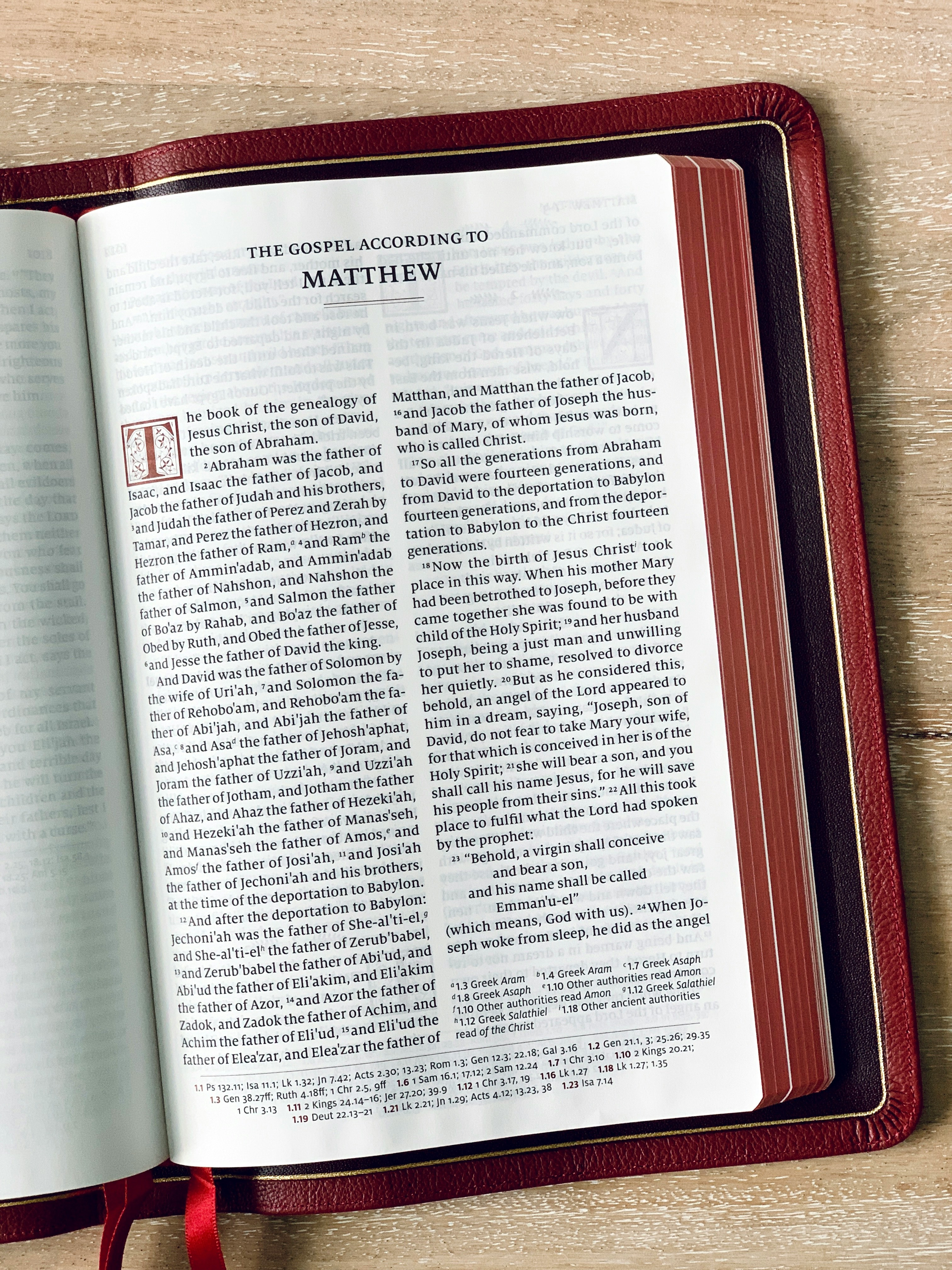
“When Jesus heard that John had been put in prison, he withdrew to Galilee. Leaving Nazareth, he went and lived in Capernaum, which was by the lake in the area of Zebulun and Naphtali—to fulfill what was said through the prophet Isaiah: “Land of Zebulun and land of Naphtali the Way of the Sea, beyond the Jordan, Galilee of the Gentiles—the people living in darkness have seen a great light; on those living in the land of the shadow of death a light has dawned.” From that time on Jesus began to preach, “Repent, for the kingdom of heaven has come near.” As Jesus was walking beside the Sea of Galilee, he saw two brothers, Simon called Peter and his brother Andrew. They were casting a net into the lake, for they were fishermen. “Come, follow me,” Jesus said, “and I will send you out to fish for people.” At once they left their nets and followed him. Going on from there, he saw two other brothers, James son of Zebedee and his brother John. They were in a boat with their father Zebedee, preparing their nets. Jesus called them, and immediately they left the boat and their father and followed him. Jesus went throughout Galilee, teaching in their synagogues, proclaiming the good news of the kingdom, and healing every disease and sickness among the people.” (Matthew 4:12-23)
We continue in the season of Epiphany with our scripture reading today, Matthew 4:12-23. Remember, the word “Epiphany” means “revealing”. During the season of Epiphany in the church lectionary calendar we read the scriptures that reveal the “big picture” of who Jesus really is. We learn what it means when the scriptures proclaim, “Jesus Christ is Lord” and “The kingdom of God is at hand”. We learn what it means when Jesus says, “All power and authority in heaven and earth has been given to me”. In the other seasons of the church year, we focus on each of the individual “confessions” about Christ that make up the gospel. So each season is like listening to one of the individual instruments in an orchestra. But during Epiphany we hear all the instruments together, playing the whole symphony!
Sadly, most Christians have never even heard of Epiphany. Christmas and Easter have been the most popular Christian religious holidays in modern times. As a result, Christians today often conclude that Christmas and Easter must be the two main parts of the Christian message. We end up thinking of Jesus as a “Christmas-Easter Jesus”, and we end up with a “Christmas-Easter gospel.” We believe that the gospel message is that God sent his Son into the world (on Christmas!) so that he would die for our sins and open the way to eternal life (at Easter!). We know that all the other things about Jesus are important, but we think that Christmas and Easter are the cornerstones of the gospel, and as long as we get people to believe in the Christmas-Easter Jesus, the rest of the details of his life and of the Christian faith can be filled in later.
But in fact, none of the four gospel writers (Matthew, Mark, Luke, or John) begin their gospels with Christmas, and none of them end their gospels with Easter. They all want to make sure we understand that Jesus is not a new character in the Bible story who first appears at Christmas and who completes his work at Easter. Jesus is not the offspring of the God of the Old Testament, whom the Old Testament God kept hidden until he sent him into the world on a mission to die for our sins. Jesus is in fact that God who has spoken since the beginning, co-equal and co-eternal with the Father and the Holy Spirit.
In other words, the New Testament doesn’t reveal “the son of the Old Testament God”. The New Testament reveals that the Old Testament God is in fact Father, Son, and Holy Spirit. So, along with all the other New Testament writers, Matthew, Mark, Luke, and John start their stories of Jesus before Christmas and continue their stories of Jesus after Easter. They don’t proclaim a “Christmas-Easter Jesus” or a “Christmas-Easter gospel”. They proclaim Jesus as the Great “I AM”—the Alpha and the Omega—the image of the invisible God. He is the one who has been speaking since the beginning—to Adam, to Abraham, to Moses, to David, and to the Prophets. He is the Word. He is the one who created all things and the one in whom all things hold together. He comes not only to die but to defeat death. Matthew, Mark, Luke, and John write their gospels not so that we respond by saying, “Thank you Jesus for dying for my sins.” They write so we will respond by falling at his feet in worship and crying out, “My Lord and my God!” That is why we have the season of Epiphany. It reveals who, and how big, Jesus is.
Jesus had gone to the south, to begin his ministry by being baptized by John the Baptist. John spoke out against King Herod because the king had married his former sister-in-law, so Herod had John arrested. When Jesus heard this, he withdrew back to the north, to Galilee, to begin his public ministry where had been raised. This was not because Jesus was running from Herod. As we see later, especially in Luke 13, Jesus knew he must enter Jerusalem freely, as its Lord, coming on the day he had appointed in the Old Testament for the city’s visitation. he would give himself up freely into the hands of Herod and the authorities only after his visitation
When the Gospel writers quote the Old Testament, it is because they want us to go back and read those scriptures. When we do that, we understand who Jesus is from Isaiah 9:6-7.
“For to us a child is born, to us a son is given, and the government will be on his shoulders. And he will be called Wonderful Counselor, Mighty God, Everlasting Father, Prince of Peace. Of the greatness of his government and peace there will be no end. He will reign on David’s throne and over his kingdom, establishing and upholding it with justice and righteousness from that time on and forever. The zeal of the Lord Almighty will accomplish this.” (Isaiah 9:6-7)
Who is Jesus? He is not the Christmas-Easter Jesus who was born to die. He is the Mighty God, the Everlasting Father, who reigns on David’s throne, who came to bring a kingdom that continues forever. Even death cannot stop his kingdom.
One of the controversies that Jesus faced was that the religious leaders claimed he could not be the Messiah because he was from Nazareth—“nowheresville”—in Galilee, which was the land of the Gentiles. But Jesus continually rebuked the religious leaders for their failure to read the scripture, which he said clearly testified of him. This scripture is a good example. Isaiah said the Messiah would indeed be from Galilee—and that he would in fact be the Mighty God himself.
In the case of every scripture, and in the case of today’s scripture reading, it is important to read the verses before and after the text at hand in order to fully understand the scripture’s context. Directly before today’s scripture reading, we read that Satan offers Jesus all “the kingdoms of the world”, and Jesus rejects the offer. And a few verses later, Jesus preaches “Repent, for the kingdom of heaven has come near”. The backdrop for Jesus’ announcement is Daniel 2:44.
“In the time of those kings, the God of heaven will set up a kingdom that will never be destroyed, nor will it be left to another people. It will crush all those kingdoms and bring them to an end, but it will itself endure forever.” (Daniel 2:44)
Jesus, here in Matthew, is the God of heaven who brings with him from heaven to earth a kingdom which will never be destroyed. Jesus doesn’t transform the kingdoms of this world into Christian kingdoms. Nor is it that Jesus’ kingdom is only in heaven and we only enter it when we die. Instead, Jesus brings a kingdom from heaven which crushes all of those kingdoms.
From the beginning of scripture, God’s purpose has always been to rule directly and personally over creation. When Adam and Eve rebel against God’s rule and place themselves under the rule of Satan, God doesn’t destroy them. Instead, God proclaims the gospel:
“…And I will put enmity between you and the woman, and between your offspring and hers; he will crush your head, and you will strike his heel.” (Genesis 3:15)
God’s direct personal rule over his people is restored through Jesus Christ, the promised offspring of the woman. God doesn’t replace non-Christian shepherds with Christian shepherds. He himself shepherds the sheep directly and personally. He himself provides all they need.
“…I will remove them from tending the flock so that the shepherds can no longer feed themselves. I will rescue my flock from their mouths, and it will no longer be food for them. “‘For this is what the Sovereign Lord says: I myself will search for my sheep and look after them.” (Ezekiel 34:9b-11)
We Christians are citizens of one kingdom: the kingdom of God. We are servants of one king: the Lord Jesus who presently rules and reigns over all people. He crushes all the kingdoms of this world, not us.
“With that, one of Jesus’ companions reached for his sword, drew it out and struck the servant of the high priest, cutting off his ear. “Put your sword back in its place,” Jesus said to him, “for all who draw the sword will die by the sword.” (Matthew 26:51-52)
“Then the end will come, when he hands over the kingdom to God the Father after he has destroyed all dominion, authority and power.” (1 Corinthians 15:24)
“The God of peace will soon crush Satan under your feet.” (Romans 16:20)
But Jesus does not crush the nations with a sword in his hand; he does it with the sword of his mouth, the sword of his word.
“Coming out of his mouth is a sharp sword with which to strike down the nations. “He will rule them with an iron scepter.” He treads the winepress of the fury of the wrath of God Almighty.” (Revelation 19:15)
Jesus presently holds all authority and we are his slaves, servants, and brothers and sisters. We submit to the authority of the rulers of this world, but we do not become involved in their work. We have our own kingdom to serve—the kingdom of heaven.
This is why for the first three hundred years of Christian history, Christians didn’t sign up to serve in the militaries or administrations of the countries they lived. And soldiers and civil servants who became Christians struggled to figure out whether they should continue to serve the kingdoms under which they had been commissioned. It was a real issue in the church. Unfortunately, the church has almost totally forgotten this today. It mistakenly believes that we serve Christ and the kingdom of heaven by serving in the kingdoms of this world.
In today’s scripture reading, in Matthew 4:17, Jesus announces that the kingdom of heaven has come, fulfilling the prophecies all the way back to the beginning of the scriptures. He says the proper response to the coming of the kingdom is for us to repent. When we hear that, we fill in our own meaning for the word “repent”. We think it means to feel genuinely sorry for our wrongdoing and to change our behavior. That is because we don’t understand the biblical meaning of sin.
Sin doesn’t just mean “bad things we do”, and repentance doesn’t just mean “stop doing those bad things.” Sin means “rebellion against the direct rule of God” and repentance means “receiving the direct rule of God.” The apostles repented by placing themselves in a position of complete dependence upon Jesus, the king of the kingdom of heaven.
“Jesus went throughout Galilee, teaching in their synagogues, proclaiming the good news of the kingdom, and healing every disease and sickness among the people” (Matthew 4:23)
Jesus did not do the works he did in order to give others a good impression about him by offering humanitarian aid. He does these works because he is carrying out the responsibilities of the king of the kingdom of heaven to his people. He frees them from captivity, shepherds them, and provides for their needs.
When missionaries go to other countries and give humanitarian aid, but do not preach the gospel, they are not imitating Jesus. Jesus announces his kingdom openly.
When Jesus dies on the Cross, he is not simply dutifully carrying out his Father’s command to die for our sins. He is carrying out his responsibilities as our king. On the cross he defeats death and all the kingdoms of this world and all the things that stand in the way of him shepherding us personally and providing for us directly.











 Do the Word